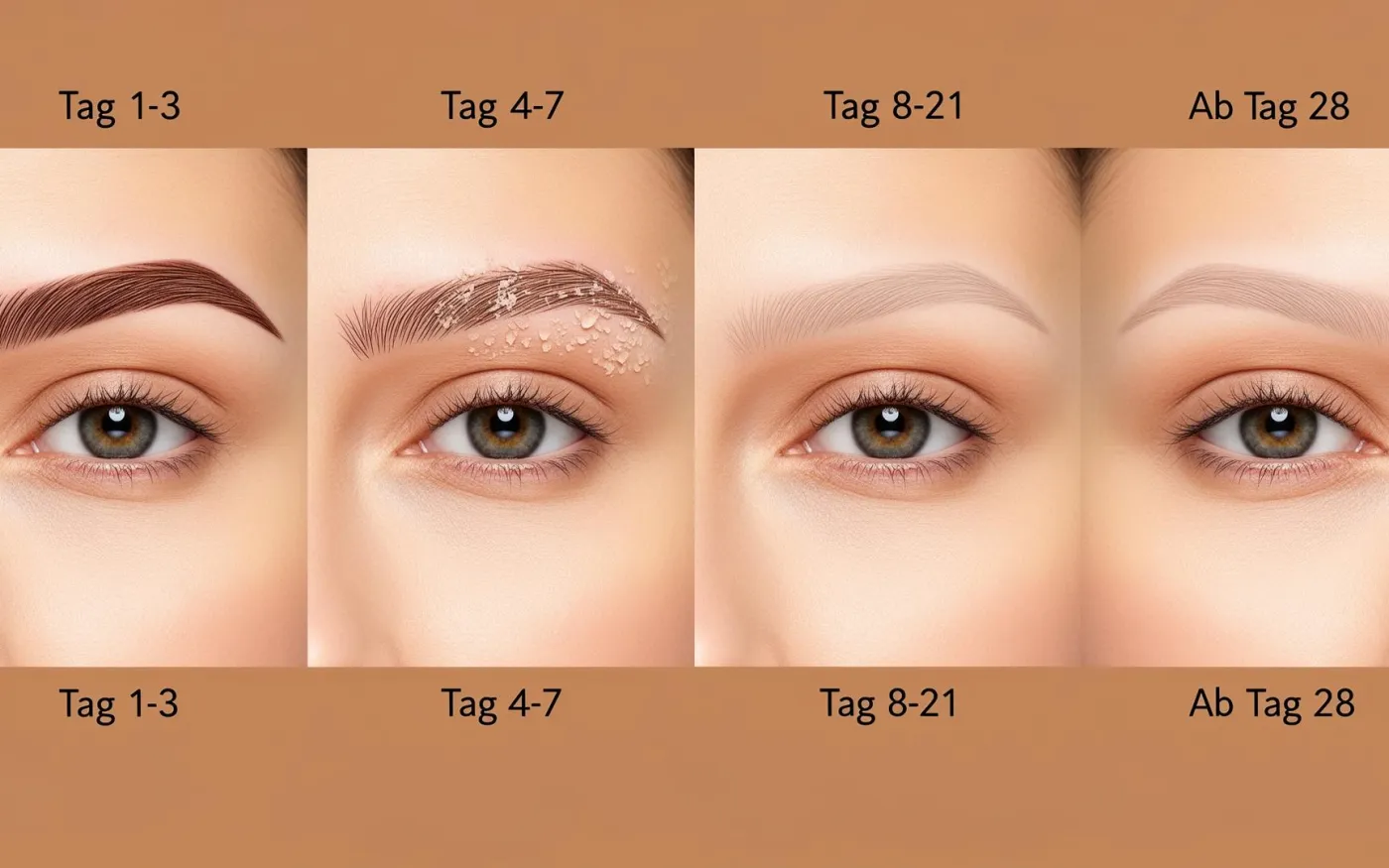




Day 1–3: Right after the treatment
You did it – your permanent make-up is fresh and you look in the mirror for the first time. And you’re probably thinking: “That’s far too dark!” Don’t worry – this is completely normal and part of the process.
In the first hours after the treatment, the colour is more intense than the final result. This is because the pigments are still at the surface of the skin and the skin is slightly swollen and red. This effect visually intensifies the colour.
What you can expect in the first few days:
- Slight swelling: especially with lip PMU, the swelling can be clearly visible. It usually subsides within 24–48 hours.
- Redness: the treated skin is irritated and shows natural redness – comparable to an intensive facial.
- Colour intensity: the colour looks 30–50% darker than the final result. This is intentional and takes into account the natural loss of colour during healing.
Care now: cleanse gently as recommended by your PMU artist. No soap, no make-up on the treated area. Apply a thin layer of the prescribed aftercare cream.
Day 4–7: Scabbing and flaking
From the fourth day, the skin begins its natural healing process: fine crusts or scabs form over the treated area. This can look worrying – the brows may look patchy, uneven or “broken”.
This is completely normal. The crusting is a sign that the skin is healing and locking in the pigments.
The most important rule in this phase: don’t scratch, don’t pick, don’t rub. As tempting as it may be – removing the scabs too early can pull out pigment and lead to uneven results.
More tips for this phase:
- Avoid prolonged contact with water (no long showers directly on the treated area, no swimming)
- No exercise – sweat can interfere with the healing process
- No sunbathing and no tanning beds
- Keep using the recommended aftercare cream
Week 2: The ghost phase
Now comes the phase that causes most clients the greatest uncertainty: the so-called “ghost phase” or “ghosting”. The scabs have come off and suddenly the colour seems to have almost completely disappeared.
This is the most common reason for panic – and at the same time the most normal part of the healing process.
What happens: the upper layer of skin has renewed itself and forms a thin, milky layer over the embedded pigments. This layer makes the colour temporarily look pale or even invisible. It’s like a frosted-glass effect over the pigmentation.
The pigments are still there – they are just temporarily covered by the fresh skin. Over the coming days and weeks, the skin becomes more transparent and the true colour gradually comes through.
My advice: be patient. Don’t judge the result in this phase. Many clients write to me worried in week 2 – and are thrilled two weeks later.
Week 3–4: The colour returns
From about the third week, the true result starts to show. The skin has regenerated further, the milky layer becomes more transparent, and the pigments shine through in their final colour intensity.
In this phase you can observe:
- The colour becomes a little more visible and defined day by day
- The contour becomes clearer
- Any irregularities that were visible during healing even out
Important: the final result can only really be judged after 4 to 6 weeks. Before that, colour intensity, shape and evenness are still changing.
If certain areas have stayed lighter after 6 weeks or the colour looks too soft overall, there’s no need to worry – that’s exactly what the touch-up appointment is for.
After healing: when does a touch-up make sense?
The touch-up appointment is an integral part of the permanent make-up process – not a sign that something went wrong.
At the touch-up, which usually takes place 4 to 8 weeks after the first treatment, the following things are optimised:
- Areas where the skin rejected more pigment are filled in
- The shape can be minimally adjusted if necessary
- The colour intensity is brought in line with the desired final result
Not every client needs an extensive touch-up – some only need minimal corrections, others benefit from more filling in. This depends on how your skin behaves and is completely normal.
Plan the touch-up as a fixed part of your treatment – it makes the difference between a good and a perfect result.