Why do people decide to have PMU removed?
The reasons why someone wants an existing permanent make-up removed are many – and all of them are completely valid. PMU removal is not an admission of a mistake but a professional solution for a changed situation.
Common reasons for removal:
- Colour change: the PMU has discoloured over time – grey, bluish or reddish instead of the desired natural tones.
- Change of shape: the shape no longer matches current aesthetic taste or was never quite right from the start.
- Change of style: what you liked five years ago no longer suits your personal style today.
- Result from another studio: not every result meets expectations – and sometimes a correction alone is not enough.
- Outdated technique: older pigmentation done with methods that are no longer up to date often looks unnatural.
Whatever the reason: the first step is always an honest consultation in which all options are discussed openly.
The remover technique: gentle removal from within
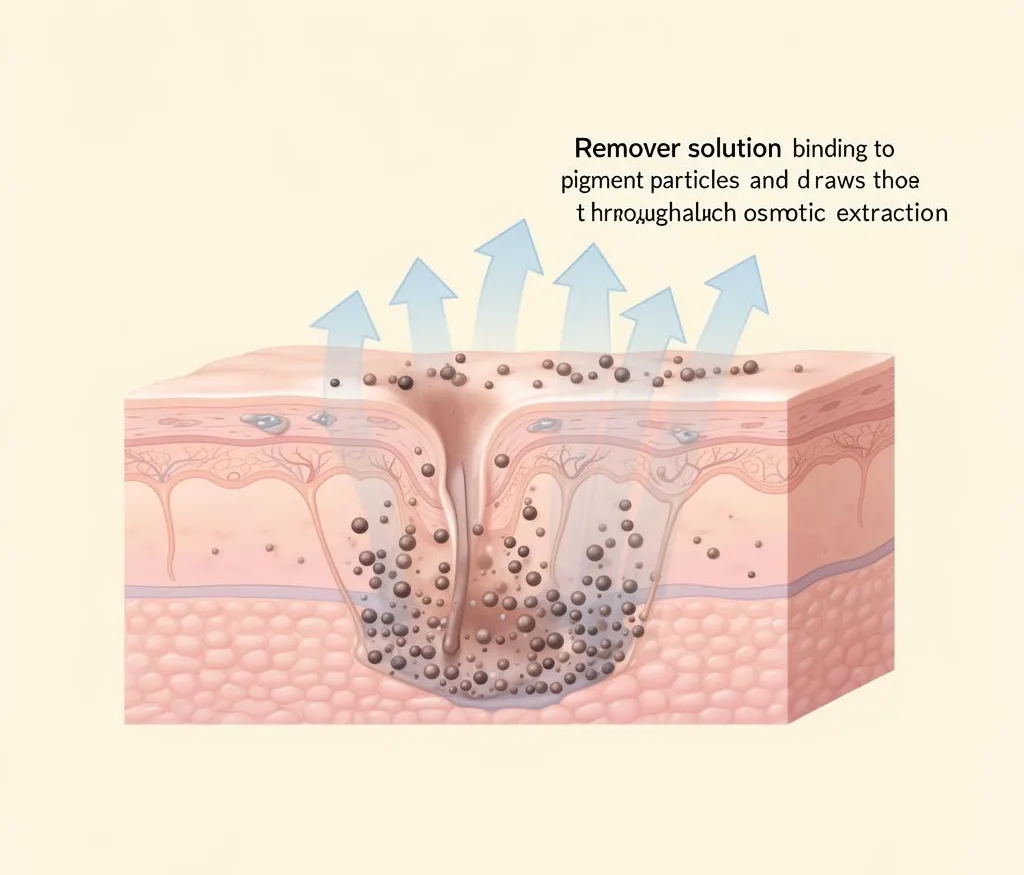
The remover technique is one of the most commonly used methods for PMU removal and is offered by many experienced PMU artists. It works on the principle of osmotic extraction: a special solution is introduced into the pigmented skin layer with a PMU device.
This solution binds the pigment particles and draws them to the surface of the skin. In the days after the treatment, a crust forms that contains the bound pigments. When the crust falls off naturally, it takes the pigments with it.
Advantages of the remover technique:
- Works on all pigment colours – including shades that are problematic for lasers
- No heat applied to the skin
- Can be applied precisely to specific areas
- The healing process is comparable to that after a normal PMU treatment
Good to know: the remover technique requires patience. There must be at least 6 to 8 weeks of healing time between individual sessions. Complete removal can take 2 to 5 sessions, depending on the density and depth of the existing pigmentation.
Why the remover technique often works better than laser
When people hear “removal”, many automatically think of laser – after all, laser technology is well known from tattoo removal. For cosmetic pigmentation, however, the remover technique is often the better choice. Here are the most important differences:
- Independent of colour: lasers struggle with warm shades (red, orange, yellow) and can even cause darkening with white or skin-coloured camouflage pigments. The remover technique works equally on all colours.
- No heat stress: while lasers work with high-energy light pulses that put thermal stress on the skin, the remover technique works without heat – which means less stress for the skin.
- Lower risk of pigmentation disorders: on darker skin tones, lasers can cause unwanted pigment changes in the surrounding skin. The remover technique does not carry this risk.
- Familiar process: healing after a remover session is similar to that after a PMU treatment – so you already know what to expect.
The remover technique is specifically designed for cosmetic pigmentation and is therefore the gentler and more reliable method for most PMU removals.
How many sessions are needed?
The honest answer: it depends. A blanket statement wouldn’t be serious, because the number of sessions needed depends on several factors:
- Age of the pigmentation: older PMU work has often already faded and can be removed more quickly.
- Depth of the pigments: the deeper the pigments sit in the skin, the more sessions are needed.
- Density of the pigmentation: areas that have been reworked several times with many layers of pigment need more time.
- Skin type and ability to regenerate: every skin reacts differently to the removal process.
- Colours used: some pigment colours are easier to remove than others.
As a rough guide: most clients need between 2 and 5 sessions for a satisfying result. There are 6 to 8 weeks of healing time between sessions. The entire process can therefore stretch over several months.
What you should clarify before removal
Before you decide on a removal method, a thorough consultation is essential. These are the most important points to raise in the preliminary conversation:
- Patch test: have a small test area treated beforehand to check how your skin reacts.
- Portfolio review: does the practitioner have experience with PMU removal? Are there documented before-and-after results?
- Pigment analysis: which colours and how many layers are present? This determines the suitable method.
- Aftercare: which care measures are needed after each session? Are there restrictions in everyday life?
- Schedule: if you plan a new pigmentation after removal, enough time must be allowed for complete healing – usually at least 3 to 6 months after the last removal session.
A reputable studio will raise all of these points on its own and draw up a realistic treatment plan for you.