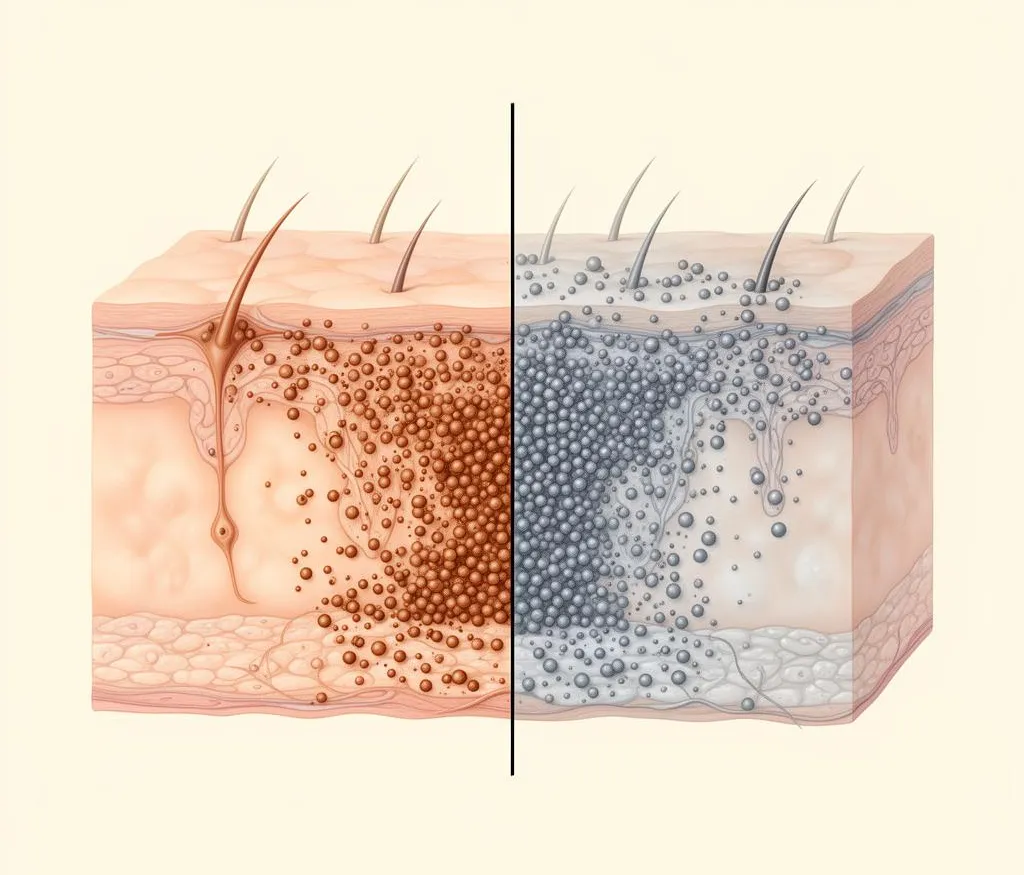
Why do brows turn grey or bluish after PMU?
It’s a moment that unsettles you: you look in the mirror and notice that your permanently pigmented brows have developed a greyish or even bluish undertone. First of all: you are not alone, and there is no reason to panic. This phenomenon has concrete, understandable causes.
The most common reason lies in the pigment formulation. Older or low-quality pigments often contain too many cool colour particles – especially blue and grey tones. If the warmer colour particles (red, orange) are broken down by the body faster than the cooler ones, the shade visibly shifts towards grey or blue.
Your skin undertone also plays a decisive role. On skin with a cool or olive undertone, certain pigments can look different than expected. What looked warm and natural in the pigment cup can appear cool in the skin due to light refraction and natural melanin content.
In addition, the needle depth can influence the result: if pigments are placed too deep in the skin, they look bluish through the overlying skin layers – a similar effect to a deeply inked tattoo.
What is the so-called block effect?
Besides the colour change, there is another problem that often weighs on clients: the “block effect”. This means the brows appear as flat, undefined blocks – without recognisable hair strokes, without a natural gradient, without dimension.
This effect is typically caused by an outdated technique in which pigments were worked into the skin as a solid area. Modern methods such as hair stroke, nano brows or ombre powder, on the other hand, create fine individual strokes or soft gradients that imitate the natural brow structure.
If you are living with such a result, it’s important to know: it’s not your fault. The technique has evolved enormously in recent years, and what used to be standard no longer meets today’s quality level.
Can grey PMU brows be corrected?
Yes – in many cases a colour correction is possible and very effective. With corrective pigmentation, warm shades are worked over the existing pigmentation to neutralise the cool grey or blue cast.
Choosing the right correction shade requires experience and expertise. An experienced PMU artist analyses the existing undertone, the current condition of the pigmentation and the skin type before determining the right correction shade.
Important: not every grey pigmentation can be worked over directly. If the existing pigmentation is too dense, too deep or too dark, it can make more sense to carry out a partial removal first before building up a new pigmentation. This takes longer but leads to a much better result.
Why the remover technique is often the better choice
Sometimes complete or partial removal of the existing pigmentation is the more sensible route – especially when the colour shift is pronounced, the block effect dominates or several old layers lie on top of each other.
Many people know laser removal from tattoos and think it must also be the first choice for PMU. In practice, however, the remover technique offers clear advantages for cosmetic pigmentation:
- Works on all pigment colours: while lasers often reach their limits with warm tones (red, orange, yellow) and light pigments, the remover technique can be used regardless of colour.
- No risk of colour inversion: with laser treatments, certain pigments – especially white or skin-coloured camouflage shades – can darken instead of fading. This risk does not exist with the remover technique.
- Gentle on the skin: the remover technique works without heat. A special solution is introduced into the pigmented skin layer and gently draws the pigments to the surface. The skin is put under less stress than with a laser pulse.
- Targeted work: the treatment can be limited precisely to certain areas – ideal if only parts of the pigmentation are problematic.
- Familiar healing process: healing after a remover session is comparable to that after a normal PMU treatment – so you already know what to expect.
Depending on the intensity of the old pigmentation, 2 to 5 sessions are needed, each with 6 to 8 weeks of healing time in between. This requires patience but leads to a clean result on which a new, modern pigmentation can then be built.
The most important step: an honest, professional consultation in which the condition of the existing pigmentation is analysed precisely and the best way forward is discussed together.
How to recognise good pigment quality in advance
To achieve an optimal result from the start, it’s worth paying attention to certain quality features when choosing a studio:
- Ask about the pigment brand: reputable studios work with certified pigments approved in the EU and can tell you the brand and ingredients.
- Discuss your skin undertone: an experienced artist will analyse your skin undertone and adapt the pigment accordingly – not simply use a standard colour.
- Look at the portfolio: pay particular attention to healed results, not just freshly pigmented photos. The healed result shows the true quality.
- Patch test: a professional studio offers you the option of an allergy test before the treatment.
- Transparent advice: if a studio doesn’t respond openly to your questions or puts you under time pressure, that’s a warning sign.